Activities
Notes on international conferences, research stays, collaborations, and real-robot experiments.
Sep 30, 2026
ICRA 2026 Paper Published on IEEE Xplore (CERNet)
Our ICRA 2026 paper, CERNet: Class-Embedding Predictive-Coding RNN for Unified Robot Motion, Recognition, and Confidence Estimation, has been officially published in the ICRA 2026 proceedings on IEEE Xplore. The publication list has been updated accordingly.
Sep 14, 2026
arXiv preprint: Can Compound Robustness Be Inferred from Single-Axis Evaluations? (LIBERO-CTRL)
Vision-language-action policies are usually evaluated one perturbation at a time, yet real deployment involves several shifts at once. We introduce LIBERO-CTRL, a six-axis benchmark that pairs each initial state across single-axis conditions and a matched simultaneous condition, exposing two opposing outcome changes that aggregate success rates cannot distinguish: emergent failures and compensated successes. Because they cancel, as many as 29.0% of matched initial states change outcome even when the aggregate looks consistent with single-axis measurements.
Aug 28, 2026
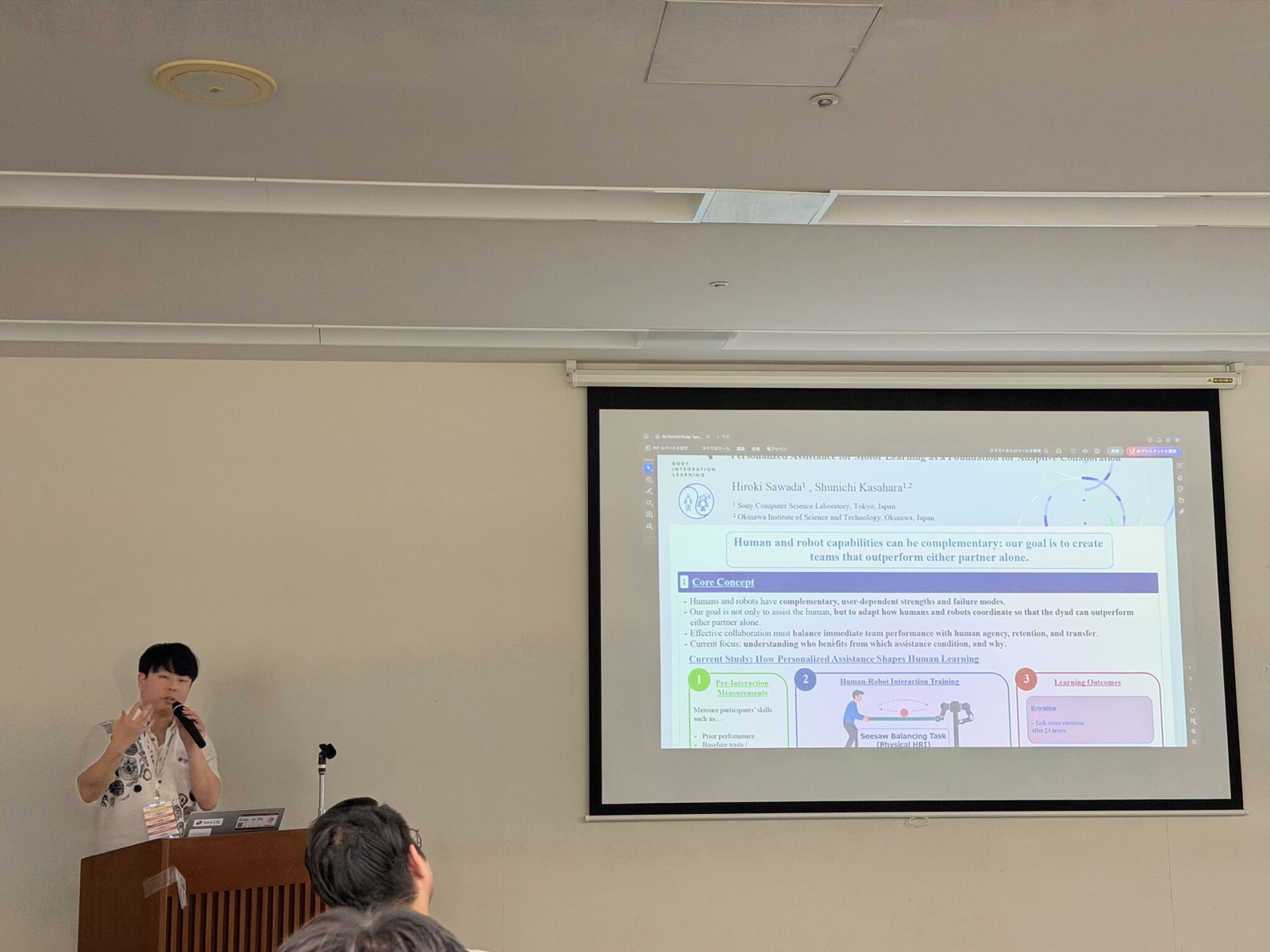
IEEE RO-MAN 2026 DIP-HRI Workshop @ Kitakyushu
I presented our early-stage work, “Toward Personalized Assistance for Motor Learning in Physical Human–Robot Interaction,” at the DIP-HRI Workshop at IEEE RO-MAN 2026. The project is still at the planning stage, exploring how robots might provide personalized assistance that supports human motor learning during physical human–robot interaction.
Aug 27, 2026
arXiv preprint: Should a Compact Robot Controller Be Organized as Observation-to-Action Mapping at All? (PredVLA)
Is compressing a large VLA really the right way to build a small robot policy? PredVLA examines this question not by shrinking observation-to-action mapping, but from a different computational principle: predicting the sensorimotor world and inferring the latent state through prediction error. With no robot-data pretraining and about 0.68M trainable parameters, it reaches 86.94% mean success across the three short-horizon LIBERO suites, far above BC-Transformer (19.73%) and BC-LSTM (10.26%) given the same parameter budget and the same frozen front end.
Aug 24, 2026
arXiv preprint: Gating Plasticity by Free Energy for Online Motor Learning (FEGP)
We released a preprint on Free-Energy-Gated Plasticity (FEGP), a method for acquiring and retaining multiple motor patterns during real-time physical human-robot interaction without pretraining, replay, or task-boundary signals. We extend PV-RNN so that it continuously adapts its synaptic weights, and gate the effective learning rate by the variational free energy so that acquiring new behaviors does not overwrite previously acquired ones.
Jun 8, 2026
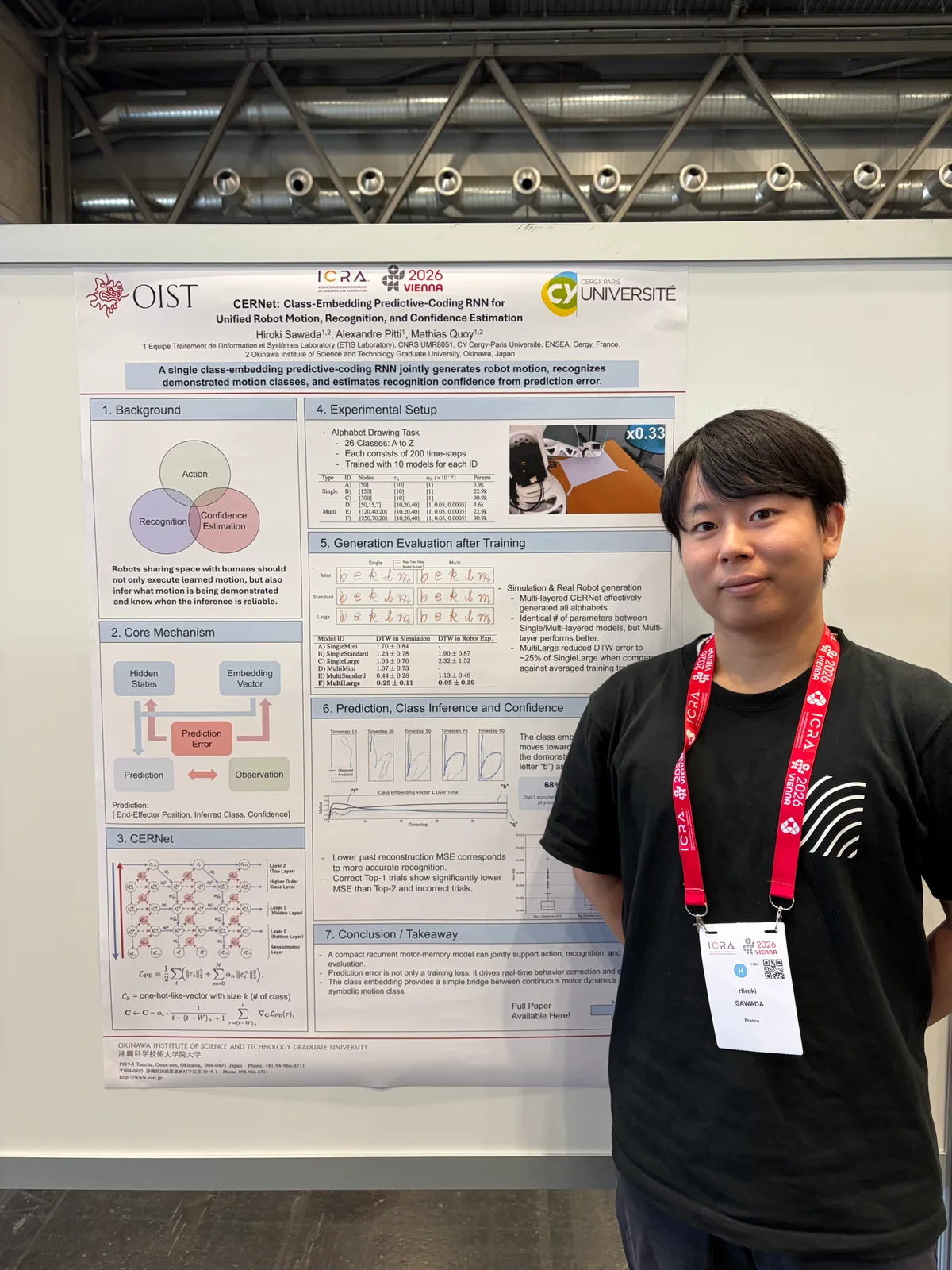
ICRA 2026 @ Vienna
I attended the IEEE International Conference on Robotics and Automation (ICRA) 2026 in Vienna and presented our work, CERNet: Class-Embedding Predictive-Coding RNN for Unified Robot Motion, Recognition, and Confidence Estimation, as a poster presentation. In this work, we proposed CERNet, a unified model that combines class embedding with a predictive-coding RNN to handle robot motion generation, recognition, and confidence estimation within a single model. The paper is expected to be published in the conference proceedings.

Jul 18, 2025
Research at CY Cergy-Paris Université
I was awarded a French government scholarship and conducted collaborative research at CY Cergy-Paris Université under the supervision of Prof. Alexandre Pitti and Prof. Mathias Quoy.

Oct 14, 2024
Participated in IROS2024 @Abu Dhabi
I participated in IROS (IEEE International Conference on Intelligent Robots and Systems) in Abu Dhabi with a Late Breaking Poster (LBP) presentation. As an extension of the Predictive-Coding inspired Variational RNN (PV-RNN), I analyzed how the internal state representations change when the number of learned motions is gradually increased through incremental learning, using principal component analysis (PCA). Since these are preliminary results, I presented them as an LBP, but I plan to further develop this work in more interesting directions in the future.